


Passenger Experience
Nearly 160 million people passed through Canada’s airports last year.
More than 100 airports serve communities in every Canadian province and territory.
Getting through an airport is supposed to feel simple. What you don’t see is everything moving together behind the scenes — thousands of people and dozens of organisations, each holding a piece of your trip. Passenger experience is a shared experience.
Airport authorities and airports do their part for passenger experience, as do the businesses and organisations working on site.
Airlines, air and baggage service providers, on-site businesses, government operational partners, regulators and policymakers each touch some part of the journey through an airport and on to where travellers are going.
Airports also work every day with surrounding communities, provinces and the federal government on local priorities, economic opportunities, and the transit, rail, street and highway connections that get people in and out.
Airports are built by their passengers
Since the airports passed from federal management to local, non-share corporation (non-profit) airport authorities in the 1990s, they have invested more than $30 billion in terminals, runways, gates and systems.
These investments haven’t been paid for by taxpayers. They’ve been paid for by airport users and businesses operating at the airports.
That work is ongoing, because an airport is never truly finished. Air hubs large and small are still building to maintain their facilities, integrate modern upgrades and create capacity to meet passenger demand. Airports across Canada have billions of dollars worth of projects under way or being planned right now: runways, terminals, baggage systems, maintenance buildings, cargo spaces and more.
Getting there is part of the journey
A trip doesn’t start at the terminal door. Airports build to accommodate the connections around them: rental cars, taxi and ride-share pick-up, connected hotels, public transit, high-frequency rail. There is also long-stay and valet parking, which can also be a source of non-aeronautical revenue that offsets improvement fees.
Retail is part of the experience
An airport is a marketplace, and while an airport doesn’t necessarily run its retail, it sets standards that every business has to meet.
Like parking revenue, retail rents are non-aeronautical revenue that gets reinvested in the airport — better facilities, better service, lower fees for passengers.
Who does what at the airport
- Airlines are responsible for bookings, check-in and baggage handling (often with the help of ground-handling contractors).
- Security screening is delivered at 89 airports by about 9,000 officers of the federal Canadian Air Transport Security Authority (CATSA). These checkpoints moved 68.9 million passengers in 2024-25 and are forecast to reach 86.3 million by the end of the decade.
- For international arrivals, the Canada Border Services Agency handles immigration and customs in the border halls.
ASQ is the gold standard – and Canada’s airports rank highly
There are numerous airport ratings and rankings, but the industry’s gold standard is Airport Service Quality, a survey program run by Airports Council International. At airports around the world, ASQ poses the same questions to passengers, asking them to rate the experience they’ve just had — this immediate feedback is what makes airports in different countries comparable.
Canada’s four largest airports average 4.09 out of 5 in ASQ. That’s better than similarly sized European airports and comparable airports in other developed countries. St. John’s, Victoria and Toronto Pearson were named best North American airports at departures for 2025.

Other awards also rank Canada’s airports highly
Other international programs support ASQ’s findings about Canadian airports, ranking them highly against North American and global peers. These include:
- Skytrax World Airport Awards, voted by travellers worldwide. Vancouver International has been voted Best Airport in North America for 15 of the last 17 years, and Canadian airports also hold Skytrax Star Certification, including a four-star rating for one of Canada’s main international hubs.
- ACI’s airport awards, judged on the passenger survey above. Toronto Pearson has won best airport in North America in the over-40-million-passengers class eight of the past nine years.
- Airport Carbon Accreditation, the only globally endorsed carbon standard for airports. Canadian airports are accredited across its levels.
- Accessibility Enhancement Accreditation, ACI’s international accessibility standard. Toronto Pearson has held its highest tier since 2024.
Passenger experience includes sense of place
From Vancouver to Fredericton, airports across Canada carry the work of local and Indigenous artists, and language and design that place you somewhere specific. Local goods and hometown brands put the flavour of the city and the province in front of residents and visitors.
New terminals are built to high environmental standards, including top-tier LEED certification at many sites. Winnipeg was home to Canada’s first LEED-certified terminal.
Passenger experience includes accessibility
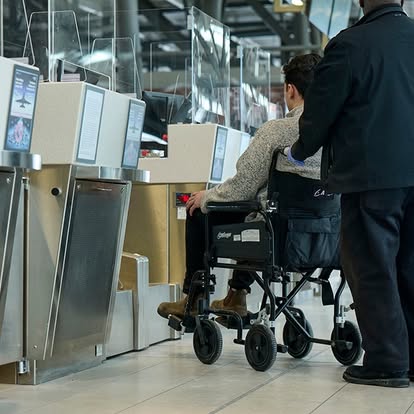
Accessibility is one of the places Canadian airports innovate most deliberately, and best practices are shared quickly.
- Fredericton put turn-by-turn audio navigation, in 18 languages, into the hands of travellers who are blind or have low vision.
- Winnipeg has installed hearing loops at every counter and gate.
- More Canadian airports every year are adopting the Hidden Disabilities Sunflower program — a quiet signal to staff that a traveller may need a little more time.

Time in an airport is time to be used.
The airport brings together the best possible offerings from a range of specialty and familiar businesses and services, holds them to a high standard, and keeps innovating as travellers’ preferences change. And through this healthy marketplace for travellers, proceeds go back into the airport system — better facilities, better service and lower costs.
Passenger experience includes airside amenities and services
Terminals across Canada host restaurants led by award-winning chefs along with familiar national and global brands and duty-free halls carrying wine, spirits, electronics, fashion and gifts made close to home.
Airlines and global hospitality brands operate premium lounges, and more airports are opening lounges any traveller can use.
Quiet spaces, children’s play areas, stroller stations, infant feeding, and even relief areas for travelling pets are increasingly standard, alongside highly trained medical, protective and emergency services on site.
Digitizing the Traveller Journey
Canada is a digital airports pioneer
The electronic border kiosks used across the country today were first developed and deployed by Canadian airports as a world-leading innovation in the run-up to the 2010 Vancouver Winter Olympics. Our airports later sold them to airports and governments around the world.
That was not a one-off. Canadian airports have spent the years since building the quiet machinery of a modern trip. Most of what an airport innovates is invisible by design: sensors and communication equipment, fuel efficiency and emissions reductions, automated equipment and upgraded machinery. It shows up as a shorter line, an on-time departure, a bag that arrives quickly, and yes – as cost reductions that support keeping airport fees low.
Twenty years later, the next generation of that technology – digital verification – is ready, and already in use in some other countries.


Between the curb and the aircraft door, you may prove who you are four or five separate times — usually to a different person at each step.
Digital verification is the future
Digital verification is a voluntary process that replaces the old process with one confirmation, which is then recognised at every step through to boarding, and again on the way home.
In countries already using digital passport control, travellers are processed 70 per cent faster and the space needed for lining up or queueing is cut in half. Costs come down for airports, airlines and government service providers, and the savings can be put back toward better service and affordability for passengers.
What airports are doing, and where they need help
Canada’s airports have been working with airline and government partners to prepare for digital verification, using proven technology already running in the United States, Singapore and the European Union. The airports are ready to go.
Three things sit on the government side of the line: updating analogue policies, retiring decades-old back-end IT infrastructure and software, and investing properly in the systems that deliver improved immigration and security screening service to the public at our airports.
Every part of your trip is held by somebody. The airport is where they all meet.
What’s next in passenger experience
These are parts of the airport where multiple organisations are focused on working together to advance passenger experience:
- Get digitalisation moving. Canada needs modernised government policy and funding measures that let digitalisation of the traveller journey proceed, building on years of commitments already made.
- Reform the federal rent formula for all airports, so that crucial revenue diverted to the federal treasury — up to 12 cents on every dollar an airport earns from its non-aeronautical business activities and other fees — can be reinvested in travellers and facilities instead of funding other government priorities.
- Fund security checkpoints on a stable multi-year basis, tied to the published service standards, so screening capacity keeps pace with the forecast growth in traveller demand in coming years.
- Eliminate policies restricting duty-free for arriving passengers, so the revenue stays in Canada instead of going to foreign airports.
- Expand data sharing and system connectivity among the ecosystem of Canadian airports, airlines, air traffic control and government agencies, so weather and network disruptions can be predicted and managed better with fewer delays and costs for all travellers and service providers.